
Frozen Door Lock in Denver? A Safe Winter Troubleshooting Guide
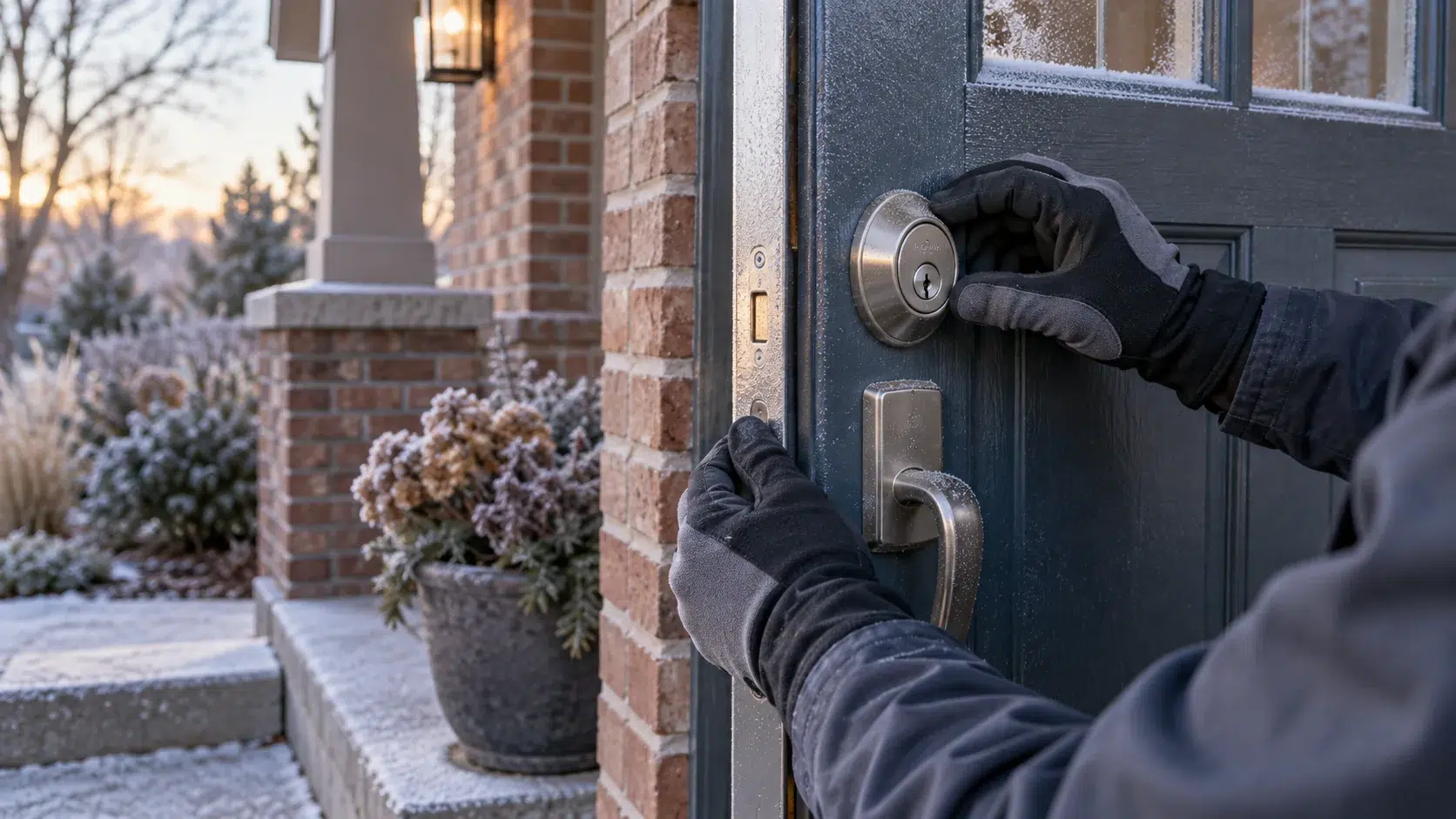


A key that stops at the face of the cylinder on a cold Denver morning may be meeting ice, but cold weather is not the only possible cause. A worn key, a dry or damaged cylinder, a door that has shifted in its frame, or a latch under pressure can feel almost the same from outside.
If you suspect a frozen door lock in Denver, stop before the key bends. Keep the door closed, remove surface moisture, warm the key gently with your hands, and use only a lock de-icer or maintenance product approved for that hardware. Do not pour hot water into the cylinder, use an open flame, or force the key. If the lock remains stiff after the ice is gone, the problem needs a mechanical inspection rather than more heat.
These steps are for ordinary exterior mechanical locks. Electronic locks, vehicle locks, fire-rated doors, access-control openings, and hardware covered by a manufacturer warranty may require a different procedure.
A frozen keyway usually appears after moisture, blowing snow, melting frost, or a rapid temperature drop. The key may not enter fully, or it may enter but refuse to rotate. Door alignment problems behave differently: the key often turns more easily when someone pushes, pulls, or lifts the door.
| What you notice | More likely cause | Safe next step |
|---|---|---|
| The key will not enter to its normal depth | Ice, debris, or internal cylinder damage | Remove surface moisture; do not drive the key inward |
| The key enters but barely turns after a wet freeze | Moisture inside the keyway | Use gentle warming or a compatible de-icer |
| The key turns when you pull or lift the door | Latch and strike misalignment | Have the door, hinges, latch, and frame checked |
| The key turns but the latch stays extended | Latch or internal lock failure | Stop cycling the key and arrange repair |
| A spare key works better than the daily key | Worn or bent key | Retire the worn key before it breaks |
| The keypad is dark or the motor stalls | Battery, temperature, alignment, or electronic fault | Follow the manufacturer’s cold-weather and backup-entry instructions |
If more than one symptom is present, a Denver residential locksmith service can evaluate the key, cylinder, latch, hinges, strike, and door movement as one system. Replacing a cylinder will not fix a sagging door, and forcing an aligned door will not melt ice.

Denver’s winter pattern is hard on exposed door hardware because moisture and temperature do not stay constant. Snow melts in daytime sun, runs toward the cylinder or door edge, and freezes again after sunset. Warm indoor air can also meet a cold exterior escutcheon and leave condensation where it is difficult to see.
The timing is not theoretical. The National Weather Service’s Denver fall and winter statistics list October 7 as the average first freeze date, while historical early freezes have arrived in September. A door that was trouble-free in August can start binding before a property owner has completed a winter maintenance round.
Repeated freezing usually points to a moisture path, not simply “bad weather.” Common sources include a missing cylinder shutter, cracked weather stripping, wind-driven snow, a poorly sealed storm door, condensation, or a door that no longer closes squarely. Correcting that path matters more than thawing the same lock every morning.
Use the normal key from both sides where appropriate. The key should enter smoothly, rotate without being forced, and release without sticking. Open and close the door several times. If the latch only catches when the door is pushed, the issue belongs on a commercial door and lock repair checklist before colder weather magnifies it.
Inspect the weather seal, threshold, door sweep, cylinder face, handle, and exterior trim. Look for gaps that direct melting snow toward the hardware. Wipe the lock dry after wet snow and keep roof or irrigation runoff away from the entry. Do not block drainage paths or add a cover that interferes with the key, handle, or required door operation.
Lock cylinders differ. A product suitable for one mechanical cylinder may be wrong for another, and electronic hardware may have additional restrictions. Check the manufacturer’s instructions before using lubricant or de-icer. Apply the minimum amount directed, then wipe away residue from the face of the hardware.
Compare the daily key with a known-good spare. Deep wear, a visible bend, a crack near the shoulder, or a key that works only at one angle is a warning. A fresh copy should be made from the best available key or from verified key information—not automatically from a badly worn duplicate.
Confirm that a second exterior door, building manager, or properly secured spare can provide access. Businesses should document who may authorize service and who holds emergency keys. A backup plan is safer than experimenting with heat or force during a storm.

A smart lock may appear frozen when its batteries are weak, its motor is pushing against a misaligned bolt, or an exterior keypad is outside its operating range. Replace or recharge batteries only as the manufacturer directs. If the manual key override is present, test it before winter—not for the first time during a lockout.
Commercial doors add closers, panic hardware, electric strikes, card readers, and door-position sensors. A reader may accept a credential while the mechanical latch remains loaded against the strike. Ice at the threshold can also prevent a closer from completing the final inches of travel. The full opening should be tested; bypassing an egress device or increasing closer force is not a safe shortcut.
If the property cannot be secured or the only authorized entrance will not open, review the site’s emergency locksmith service. Share the address, door type, lock type, weather conditions, whether the key enters, whether it turns, and whether the door is currently open or closed. That description helps separate a lockout from a repair call.
Freezing alone does not normally require new keys. If a key is missing or access control has changed, rekeying compatible locks may address key control. If the cylinder is corroded, cracked, obsolete, or unsuitable for the opening, a lock change may be more reliable than another temporary thaw.
No. Hot water can refreeze inside the cylinder or around the threshold, damage finishes, and leave the entry more hazardous. Remove surface snow, dry the hardware, warm the key gently, and use a purpose-made lock de-icer only when it is compatible with the lock.
Warm air can help in a controlled, dry setting, but outdoor electricity, wet steps, glass, finishes, seals, and electronic components create risks. Never use a heat gun or open flame. When safe access to power and moisture protection are uncertain, use a compatible de-icer or call for service.
Use only a product approved by the lock manufacturer for that cylinder and climate. Locks have different materials, tolerances, and electronic components. Avoid assuming that household oil, grease, graphite, or one universal spray is suitable for every lock.
Moisture is probably reaching the cylinder or door edge again. Check wind-driven snow, condensation, damaged weather stripping, runoff, and door alignment. Repeated freezing can also expose corrosion or internal wear that needs repair.
They can be affected by weak batteries, low-temperature operating limits, moisture, and a bolt that is binding against the strike. Check the model’s rated temperature range and backup-entry instructions. If the motor strains or the door must be pushed to lock, correct the alignment instead of repeatedly cycling it.
Not automatically. A sound lock may only need drying, compatible maintenance, and correction of the moisture source. Replacement is more appropriate when the cylinder is damaged, corroded, unreliable, or unsuitable for the door. Rekeying changes which key operates a compatible lock; it does not repair freeze damage.
A frozen lock is a reason to slow down, not twist harder. Dry the exterior, use gentle and compatible thawing methods, test the complete door, and fix the moisture or alignment problem that allowed the freeze to happen. The safest result is not merely a key that turns once; it is a door that opens, closes, latches, and remains reliable through Denver’s next temperature swing.